
Researchers from the Telecommunications & Remote Sensing Laboratory of the University of Pavia presented two research contributions at the 14th IEEE International Conference on Wireless for Space and Extreme Environments (WiSEE 2026), held in Leuven, Belgium.
The first work, “A Comparative Study of ECG Denoising Methods for Wearable Applications,” was presented during the Wireless Communication and Sensing for Humans and Living Systems in Space (WiLS-Space) Workshop.
The paper, authored by Bamrung Tausiesakul, Anna Marcucci, Amin Damrah, Mauro Marchese, Pietro Savazzi, and Anna Vizziello, investigates signal-processing techniques for improving the quality of ECG signals acquired by wearable devices. In particular, the study compares several state-of-the-art denoising methods using real upper-arm ECG recordings, a comfortable but challenging measurement location because of motion artifacts and reduced signal quality.
The different techniques were evaluated in terms of both signal-to-noise ratio improvement and preservation of the QRS morphology, providing useful indications for the design of reliable wearable systems for continuous physiological monitoring, including Wireless Body Area Network applications during space missions.
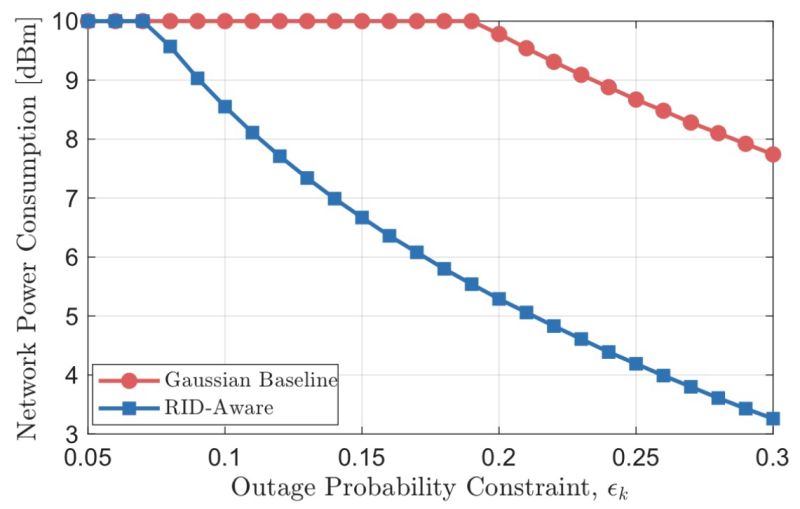
A second contribution, “Power Reduction in Heterogeneous Wireless Sensor Networks via Source-Aware Allocation,” by Mauro Marchese and Pietro Savazzi, focused on improving the energy efficiency of heterogeneous wireless sensor networks operating in space and extreme environments.
The proposed approach introduces a source-aware resource allocation framework in which transmission power and bandwidth are assigned according not only to communication-channel requirements but also to the intrinsic complexity of the physical information generated by each sensor.
The work derives an information-theoretic lower bound on the SNR required for source reconstruction based on the Rényi information dimension (RID) and exploits this metric to jointly optimize power and bandwidth allocation. Simulation results show that taking the characteristics of the transmitted source into account can provide significant power savings compared with conventional source-independent allocation approaches.
Together, the two contributions highlight the broad research activities of the TLC Lab in the field of communications and sensing for space and extreme environments, ranging from energy-efficient wireless sensor networks to wearable biomedical signal processing.